
Companies usually stop growing for one of three root causes: an operating model that no longer scales, leadership that has become the bottleneck, or intelligence gaps that hide what the market is actually doing. If you are wondering "why is my company not growing," the fix depends on which of these is true for you. A growth architect diagnoses the real constraint first, then applies the right fix: a fractional COO through GoScale Partners rebuilds the systems and delegation that unlock scale, while optimized media intelligence keeps your decisions grounded in current market reality.
You reached the revenue target or secured the funding round that was supposed to catapult your business to the next level, yet the trajectory has suddenly flattened. This invisible wall is a common symptom of a strategy that has outlived its environment; what got you here will not sustain your ascent to the next tier of scale. Ignoring these signals transforms a temporary plateau into a systemic crisis that erodes market share and talent. In this analysis, we will identify the seven critical signs of stagnation and examine the Founder Bottleneck through the lens of the Vettara Framework. You will learn how to leverage Media Intelligence and bridge the MIPO and MAPO data gaps to diagnose internal friction. By the end, you will have a practical roadmap to move from strategic paralysis to disciplined, data-driven execution.
The Invisible Wall: Why Growth Plateaus Are a Signal, Not a Failure

Every successful enterprise eventually hits an invisible wall. In my three decades of media intelligence and strategic leadership, I have seen this phenomenon across Omaha and the national landscape. This is not a failure; it is a signal that your business has reached an inflection point. The systems, workflows, and communication styles that facilitated your initial climb to a certain revenue milestone are rarely the same ones required to surpass it.
When founders ask, "why is my company not growing," the answer often lies in a mismatch between current operations and the next level of scale. It is crucial to differentiate between a temporary slow period, perhaps caused by a seasonal dip or a specific market shift, and a structural stall. A temporary slow period is a fluctuation. A structural stall is a plateau where increased effort no longer yields proportional results.
Growth Phase | Driving Force | Primary Constraint |
|---|---|---|
Startup | Founder Grit | Capital and Market Fit |
Scale-up | Repeatable Systems | Leadership Bandwidth |
Enterprise | Strategic Intelligence | Cultural Rigidity |
Hitting this ceiling usually indicates that the founding systems have been stretched to their breaking point. Through business growth consulting, we identify these specific friction points. The problem is rarely a lack of effort or a sudden loss of talent. More often, the organization is running a legacy operating system while trying to execute modern, high-volume tasks. Recognizing this shift early allows you to pivot from reactive management to proactive, systems-led growth before the plateau becomes a crisis.
Recognizing the Seven Signs That Stagnation Is Turning Into a Crisis
Identifying the difference between a sluggish market and internal rot is essential for survival. While macroeconomic shifts in 2026 might explain why business feels slow, they rarely explain a complete collapse in momentum. If you are asking, "why is my company not growing," you must look at specific indicators that suggest a plateau is actually a precursor to a crash. These symptoms are internal, structural, and often ignored until they become terminal.
High Talent Turnover: When your high impact employees leave, it is rarely just about compensation; it is a sign that your operational chaos has outpaced their ability to contribute.
CAC Exceeding LTV: If your customer acquisition cost is higher than the lifetime value of that customer, you are effectively paying to lose money.
Founder Decision Bottlenecks: Growth stops when every minor invoice or client email requires the founder’s eyes.
Acquisition Masking Attrition: You are buying new leads solely to replace the ones you are losing, resulting in net zero progress.
Flawed Forecasting: Sales targets are based on hope rather than a repeatable, data driven revenue system.
Operational Friction: Simple tasks now require multiple meetings and layers of approval, signaling that your original systems are broken.
Data Ignorance: You are making strategic decisions based on outdated reports or gut feelings because your intelligence processes have stalled.
Indicator | Market Fluctuation | Structural Crisis |
|---|---|---|
Revenue | Industry wide dip | Stagnation despite high market demand |
Personnel | Seasonal or standard attrition | Exit of key leadership and high performers |
Marketing | Rising platform costs | Inefficient spend across every channel |
Unlike a temporary dip in the Omaha market, these signs indicate that your current trajectory is unsustainable. Through business growth consulting, we often find that these issues are not caused by a lack of effort, but by a refusal to evolve the leadership structure. The very grit that built the company eventually becomes the friction that prevents it from reaching the next milestone.
The Founder Bottleneck: How Successful Leadership Can Hinder Scale
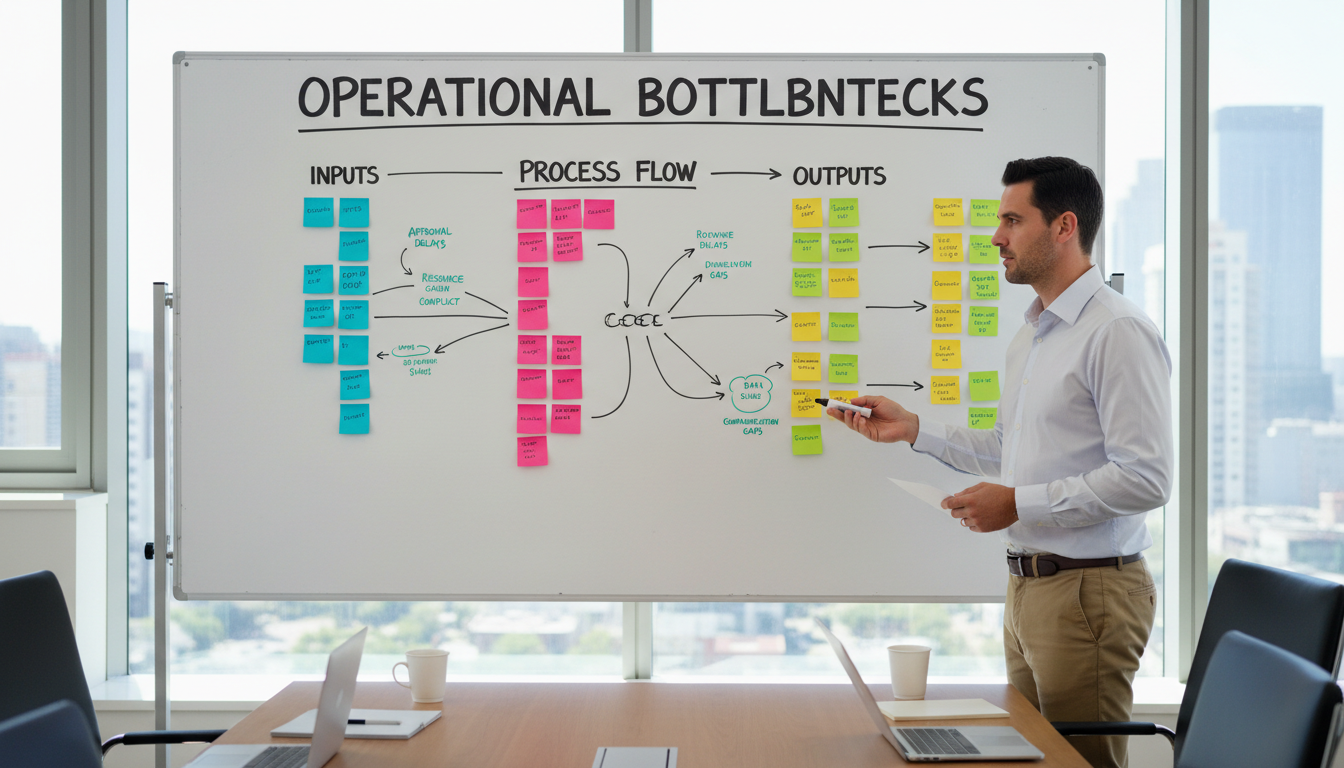
The primary obstacle to scale is rarely the market or the product; it is often the very founder who willed the company into existence. In the startup phase, a hands-on approach is necessary for survival. However, as you scale, this grit transforms into a bottleneck. When every client contract, hiring decision, and operational pivot must pass through a single person, the organization’s velocity is limited by that individual’s biological bandwidth. This is a frequent answer to why is my company not growing. The business has outgrown its reliance on personality and must now rely on process.
In Omaha, I often observe founders who struggle to delegate strategic oversight as they attempt to move from local dominance to national markets. There is a deep-seated desire to maintain a personal touch by staying involved in every tactical detail. Unfortunately, this reactive management style prevents the implementation of a proactive revenue system. To break this cycle, leadership must transition from being the primary engine of execution to the architect of the system.
Leadership Stage | Role Focus | Operational Style |
|---|---|---|
Early Growth | Execution | Founder-Led / Tactical |
Mid-Scale | Orchestration | Systems-Led / Delegated |
National Scale | Governance | Data-Led / Strategic |
Introducing fractional COO consulting through GoScale Partners LLC provides the structural bridge for this transition. A fractional executive implements the repeatable workflows and accountability frameworks that allow a founder to step back from daily fires. By installing these systems, the company moves away from a culture of asking permission to a culture of executing strategy, ensuring that growth is no longer tethered to a single person’s schedule.
Media Intelligence and Data Gaps: The MIPO and MAPO Perspective

A structural plateau is often fueled by an information deficit. When looking for the answer to why is my company not growing, many executives look at their sales team or their marketing spend, yet they overlook the quality of the data driving those functions. In my work with media monitoring and PR measurement firms, I focus on two critical frameworks: Media Intelligence Process Optimization (MIPO) and Media Analysis Process Optimization (MAPO). These are not just technical audits; they are strategic evaluations of how your company perceives the market and how the market perceives your brand.
If your growth has stalled, it is likely that your intelligence is outdated. You may be making high stakes decisions based on market sentiments that have long since shifted, or relying on inefficient PR measurement techniques that value volume over impact. While many advisors simply suggest better marketing as the cure, adding more fuel to a broken engine rarely produces results. True business growth consulting requires a shift from reactive data collection to proactive, optimized intelligence.
Framework | Focus Area | Impact on Growth |
|---|---|---|
MIPO | Workflow and Collection | Eliminates noise; ensures data accuracy, speed, and cost efficiency. |
MAPO | Interpretation and Strategy | Converts raw data into actionable insights for executive leadership. |
You cannot grow what you aren't accurately measuring. Without optimized intelligence processes, your strategy is based on noise. By refining how your organization captures and analyzes media data, you move from guesswork to a precision based growth model. This ensures every strategic pivot is backed by real time market realities rather than legacy assumptions or gut feelings.
Evaluating Internal Dynamics With the Vettara Framework
Even with optimized data processes, growth will stall if the leadership team lacks the specific cognitive and behavioral alignment required for the next phase of scale. Many executives asking "why is my company not growing" focus exclusively on market demand or capital access. However, growth plateaus are frequently human capital problems disguised as financial or marketing failures. The Vettara SaaS platform provides the objective framework necessary to diagnose these internal inhibitors by evaluating founder and leadership competencies against current organizational needs.
Subjectivity is the enemy of scale. The Vettara framework moves beyond gut feelings to provide a structured assessment of how leadership styles impact operational velocity. It identifies whether a founder’s original builder mindset has become a barrier to the architect mindset required for institutional growth. Through business growth consulting, we use these assessments to rebalance teams and ensure that individuals in key roles possess the specific skill sets needed to manage increased complexity.
Scaling Phase | Leadership Requirement | Potential Inhibitor |
|---|---|---|
Early Stage | Entrepreneurial Agility | Individual Decision Bottlenecks |
Mid-Scale | Operational Excellence | Lack of Delegated Authority |
High-Scale | Strategic Governance | Rigid Leadership Styles |
Auditing human capital with the same rigor applied to financial statements allows you to identify the specific gaps preventing your transition to the next milestone. This ensures the leadership team functions as an accelerator of growth rather than a source of structural friction.
Developing a Growth Roadmap: From Diagnosis to Execution
Transitioning from diagnosis to execution requires a move from grit to governance. Once the Vettara SaaS platform has identified the leadership gaps and your intelligence processes are optimized, the focus must shift to structural evolution. Breaking through a ceiling is not about working more hours; it is about re-engineering the firm to handle volume without increased friction.
The Growth Roadmap
Audit for Scalability: Review every core workflow. If a process relies on "tribal knowledge" or a specific veteran employee’s intuition, it is a liability. For a business to scale, every task from client onboarding to financial reporting must be documented and repeatable. Scaling requires removing the artisanal approach to operations.
Build a Proactive Revenue System: Many Omaha firms rely on reputation and word of mouth. While these are valuable, they are reactive. A proactive system uses data driven forecasting and a repeatable sales engine. If you are questioning why is my company not growing, you have likely reached the natural limit of your personal network and must now build an outbound machine.
Formalize Strategic Oversight: Midwest values often prioritize "steady as she goes" stability. While this preserves capital, it can lead to conservative decisions that ignore necessary market pivots. Establishing an advisory board or engaging in business growth consulting provides the external friction needed to challenge "safe" logic.
Focus Area | Reactive State (Plateau) | Proactive State (Scale) |
|---|---|---|
Operations | Founder-dependent tasks | Documented SOPs and automation |
Sales | Referral-based; inconsistent | Data-driven; repeatable pipeline |
Leadership | Tactical fire-fighting | Strategic oversight via fractional COO consulting |
Success at this stage is defined by your ability to step back from the daily grind and work on the business. You rebuild workflows, systematize revenue, and bring in outside perspective so the next milestone does not hit the same ceiling. That is the role of a growth architect: diagnose the constraint, align the team around the fix, and rebuild the operating model that carries you forward. If the bottleneck is leadership bandwidth or systems, a fractional COO through GoScale Partners gives you that senior operator without the full-time commitment. Ready to find out which lever is actually holding your growth back? Let's start with a growth consulting diagnosis.