
For years, the answer to a weak sales pipeline has been remarkably predictable. Hire another SDR. Buy another sales tool. Send more email. Make more calls. Increase the cadence.
When that does not work, we hire a "better" SDR.
When that does not work, maybe it is time for a new CRO.
At some point, we should consider another possibility.
Maybe the people are not the problem. Maybe the model is.
The Diminishing Returns of the Volume Game
The landscape of business development in 2026 has reached a saturation point where the traditional spray and pray model is no longer just inefficient; it is actively working against you. The numbers tell a frustrating story. FirstSales reports that average cold-email performance has settled around a 27.7% open rate and a 3.43% reply rate, with meeting booking hovering near 1% and conversion around 0.7%. Open rates, meanwhile, are increasingly unreliable because privacy protections can inflate them. Getting opened and earning attention are no longer the same thing.
The SaaS contrast makes the point even sharper. There, FirstSales reports open rates as high as 47.1% alongside reply rates below 1% and meeting-booking rates between 0.3% and 0.8%. People are opening the email. They are just not engaging, because the message was never relevant to them.
None of this means cold email is dead. FirstSales is equally clear that elite performers dramatically outperform these averages. What separates them is not more volume. It is tight targeting, genuine relevance, and disciplined execution. The same report, in other words, proves both sides of the argument: mass outbound is in decline, and targeted outbound still works.
From my perspective in business growth consulting, this trend represents more than a tactical marketing hurdle. It is a strategic leadership failure. When a founder or executive defaults to sending thousands of generic emails, they are often using volume to mask a fundamental lack of market understanding. It is easier to hit send on a massive list than it is to perform the rigorous analysis required to identify high value targets. At GoScale Partners, we view this reliance on quantity as a symptom of a weak Value Proposition.
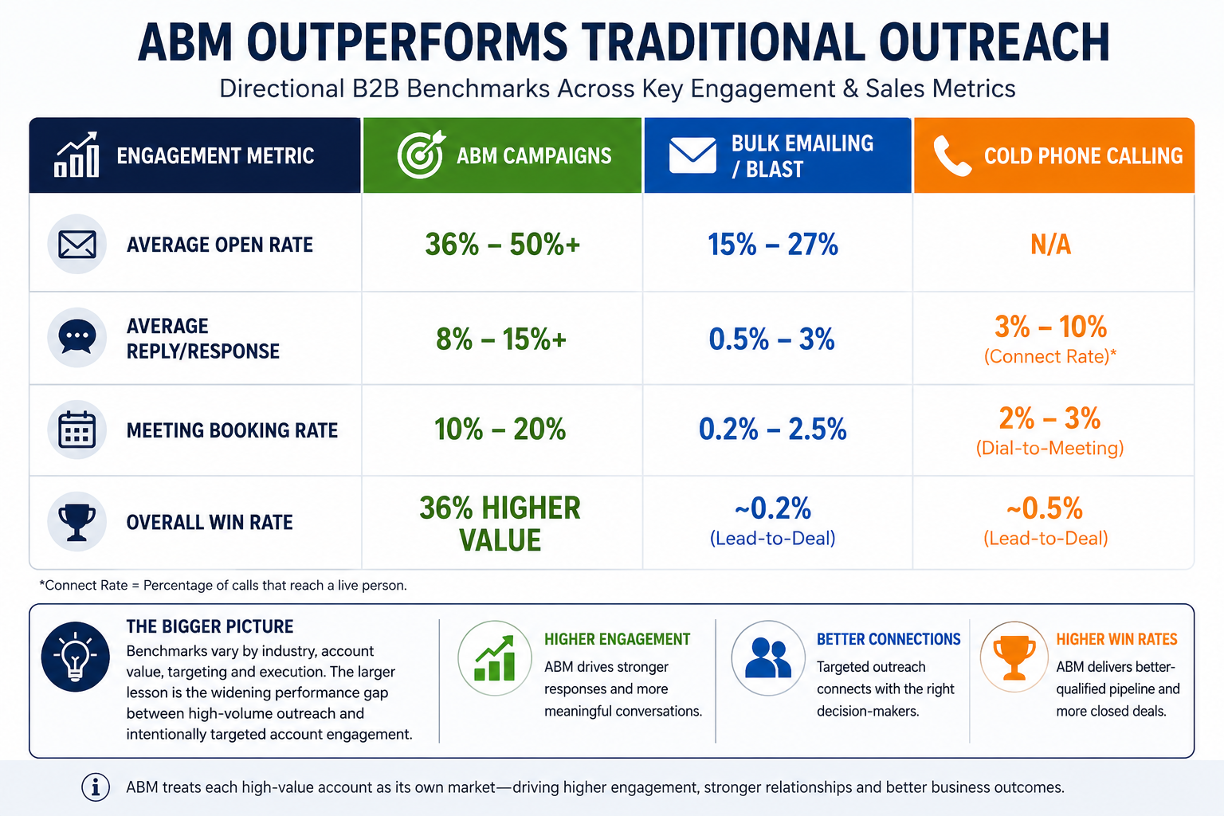
Directional B2B benchmarks vary by industry, account value, targeting and execution. The larger lesson is the widening performance gap between high-volume outreach and intentionally targeted account engagement.
Comparing the effectiveness of account based marketing vs spray and pray outbound is not just about changing software; it is about maturing the organization's approach to market entry. High volume models focus on activity rather than impact. In 2026, the competitive advantage belongs to leaders who trade the broad, shallow reach of legacy outbound for the precision of intelligence led growth. Strategic leadership guidance requires the discipline to stop shouting at the crowd and start engaging with the accounts that actually move the needle for the bottom line.
Volume Is Becoming the Enemy
Cold calling tells the same story in starker economic terms. DemandNexus reports that only about 4% to 9% of B2B cold-call attempts reach a live person, and roughly 2% of cold calls result in an appointment on average. A typical SDR may need 40 to 80 dials to generate a single qualified meeting, and calls from unknown numbers answer at substantially lower rates.
This is not an argument that nobody answers the phone. It is an argument about the cost of each meaningful conversation. When a poorly targeted account requires dozens of dials and still rarely converts, the human labor behind that effort becomes hard to justify. An SDR working 500 poorly selected accounts does not become more effective just because management hands that SDR a better script.
Here is the uncomfortable truth underneath those numbers: we solved the cost of sending outbound messages and accidentally destroyed the scarcity that once made those messages valuable. Historically, scaling outreach was difficult because humans had to do the work. Now AI and sales automation let a company generate thousands of emails, calls, and follow-ups at minimal incremental cost. But every seller has access to the same leverage, so the result is more noise competing for the same finite attention. Increasing volume without better targeting simply creates more noise, and AI cannot fix irrelevant outreach by producing irrelevant outreach a hundred times faster.
Account Based Marketing vs Spray and Pray Outbound: Defining the Shift
To evolve beyond the volume trap, leadership must distinguish between reactive tactics and coordinated strategy. Spray and pray outbound is fundamentally quantity-focused. It operates on the assumption that casting a wide enough net will eventually yield a result, relying entirely on the law of large numbers. This approach is reactive; it forces sales teams to sort through low-quality noise rather than focusing on high-intent targets. It treats the market as a monolithic entity, ignoring the unique pain points of individual organizations.
Account Based Marketing (ABM) represents a total shift in perspective. It is a coordinated strategy where sales and marketing align to treat a specific, high-value account as a market of one. LinkedIn data suggests that engaging the right 300 accounts is significantly more valuable than blasting 2,500 generic ones. This precision ensures that resources are allocated to accounts with the highest probability of conversion and the greatest lifetime value. At GoScale Partners, we define the shift as moving from a broadcast mindset to a surgical one.
What is Account-Based Marketing?
Account-Based Marketing, or ABM, is a B2B growth strategy that identifies a limited group of high-value prospective accounts first, then treats each account as its own market. Sales and marketing work together to understand the company, its decision-makers, its business problems, and its buying environment before initiating outreach.
Execution of this strategy typically follows three distinct tiers:
1:1 (Bespoke): Deeply researched, highly personalized outreach for accounts with the highest potential revenue. Every touchpoint is unique to that specific firm.
1:few (Cluster): Tailored campaigns for small groups of accounts that share similar industry dynamics or business challenges.
1:many (Programmatic): Technology-driven outreach that scales personalization across a broader, but still highly qualified, list of targets.
In the context of business growth consulting, true ABM is about defining exactly who you want as customers before the first message is ever drafted. It is not just about changing the tools in your tech stack; it is about maturing the organizational approach to market entry. When leadership prioritizes quality over the sheer volume of outbound activity, the firm builds a foundation for sustainable, high-margin growth.
The ROI of Precision: Why Targeted Campaigns Outperform
The transition from high-volume outreach to precision is best justified by the hard math of efficiency. Cleverly's micro-segmentation analysis reports that campaigns targeting fewer than 50 recipients averaged roughly a 5.8% reply rate, compared with about 2.1% for campaigns sent to more than 1,000 contacts. This is not a marginal gain; it is a fundamental shift in the economics of customer acquisition, and it sits directly alongside the same warning Cleverly makes elsewhere: increasing volume without better targeting simply creates more noise.
MotionABX reports research showing materially larger contract values from account-based approaches, reinforcing that the payoff is not only more conversations but larger, higher-value deals when those conversations are aimed at the right accounts.
The metrics that drive business growth consulting outcomes are never vanity numbers like "total emails sent" or "general click-through rates." Those are activity metrics, not impact metrics. What matters is account penetration, account engagement, pipeline velocity, and account win rate: the measures of whether the right organizations are genuinely moving toward revenue.
True strategic leadership guidance requires focusing on pipeline velocity and win rates. By prioritizing account penetration, a firm ensures its team is engaging multiple stakeholders within a high-value organization. This depth of engagement shortens the sales cycle and increases the predictability of the revenue forecast, moving the organization away from the volatility of broad, shallow outreach.
Leveraging Media Intelligence to Identify High Value Targets
Precision in the debate of account based marketing vs spray and pray outbound relies entirely on the quality of your inputs. This is where Media Intelligence Process Optimization (MIPO) transforms outreach from a guessing game into a surgical strike. By integrating media monitoring and PR measurement into the initial research phase, executives can identify intent signals that traditional lead lists simply miss.
A target account’s media footprint reveals the critical timing required for successful conversion. Significant leadership changes, aggressive expansion into new markets, or specific regulatory challenges mentioned in local press provide the context needed for high-level personalization. When a founder utilizes media intelligence, they are no longer just sending an email; they are responding to a documented organizational shift.
At GoScale Partners, we emphasize that intelligence-led growth is the strategic antidote to digital noise. Understanding how to parse media data allows a firm to prioritize accounts based on real-time activity rather than static, outdated demographics. This level of strategic leadership guidance ensures that your sales team engages only when the probability of relevance is at its peak. By mastering the business growth consulting aspect of media analysis, firms can preemptively address a prospect’s pain points, securing a seat at the table before a formal RFP is ever issued.
The Executive Leadership Perspective: Moving from Activity to Impact
Transitioning from media signals to execution requires a fundamental shift in executive philosophy. Many founders are addicted to the hustle metrics of high volume; however, effective business growth consulting demonstrates that true scale originates from patience and precision. The GoScale Partners approach views this transition as a long term investment in brand equity rather than a series of short term spikes. When evaluating account based marketing vs spray and pray outbound, a fractional COO prioritizes the health of the pipeline and the depth of market penetration over the hollow dopamine hit of a high sent count.
Success hinges on absolute alignment between sales and marketing, which is often the primary hurdle for growth stage firms. If these departments operate in silos, the precision of an intelligence led strategy dissolves into fragmented noise. Leadership must facilitate a culture where marketing is measured by revenue contribution and sales is measured by account engagement. To determine if a leadership team is ready for this shift, I utilize founder assessment tools like Vettara to provide strategic leadership guidance. These tools identify whether the current team possesses the analytical discipline and collaborative mindset required to execute a precision led strategy. Moving from activity to impact is a marathon that requires a steady, strategic hand at the top.
How to Transition Without Losing Momentum
Transitioning from a high-volume model requires a calculated pivot to maintain revenue flow while shifting gears. Begin by auditing existing data quality; precision is impossible if your CRM is cluttered with outdated contacts or incorrect firmographics. High-level outreach fails when it is built on a foundation of poor information. Next, define an Ideal Customer Profile (ICP) by rigorously analyzing historical win data. Identify the characteristics of your most profitable, long-term clients rather than just any firm that signed a contract. This internal clarity is essential for successful business growth consulting outcomes.
Once the foundation is set, implement a pilot 1:few campaign targeting a tight cluster of high-value accounts. This allows your team to refine messaging and workflows without the risk of a full-scale organizational overhaul. I recommend using the Vettara platform to assess your team’s readiness for this change, as the shift in mindset from quantity to quality is often the most significant hurdle. In the ongoing debate of account based marketing vs spray and pray outbound, remember that this transition is a marathon, not a sprint. At GoScale Partners, we provide strategic leadership guidance to ensure that as you tighten your focus, you simultaneously expand your market impact.
Transitioning from a broad outbound approach to Account-Based Marketing is no longer optional for businesses seeking sustainable revenue. By focusing your limited resources on high-value targets, you prioritize quality over noise. This is exactly where a growth architect earns the role: someone who diagnoses the broken funnel before prescribing more activity, and who rebuilds the model so every dollar targets an account that can actually become a customer. If you want to implement this strategy but feel overwhelmed by the technical setup, my Growth Consulting offers a way to streamline the process. Reach out and we can build a precise, effective system that secures the accounts that matter to your bottom line.